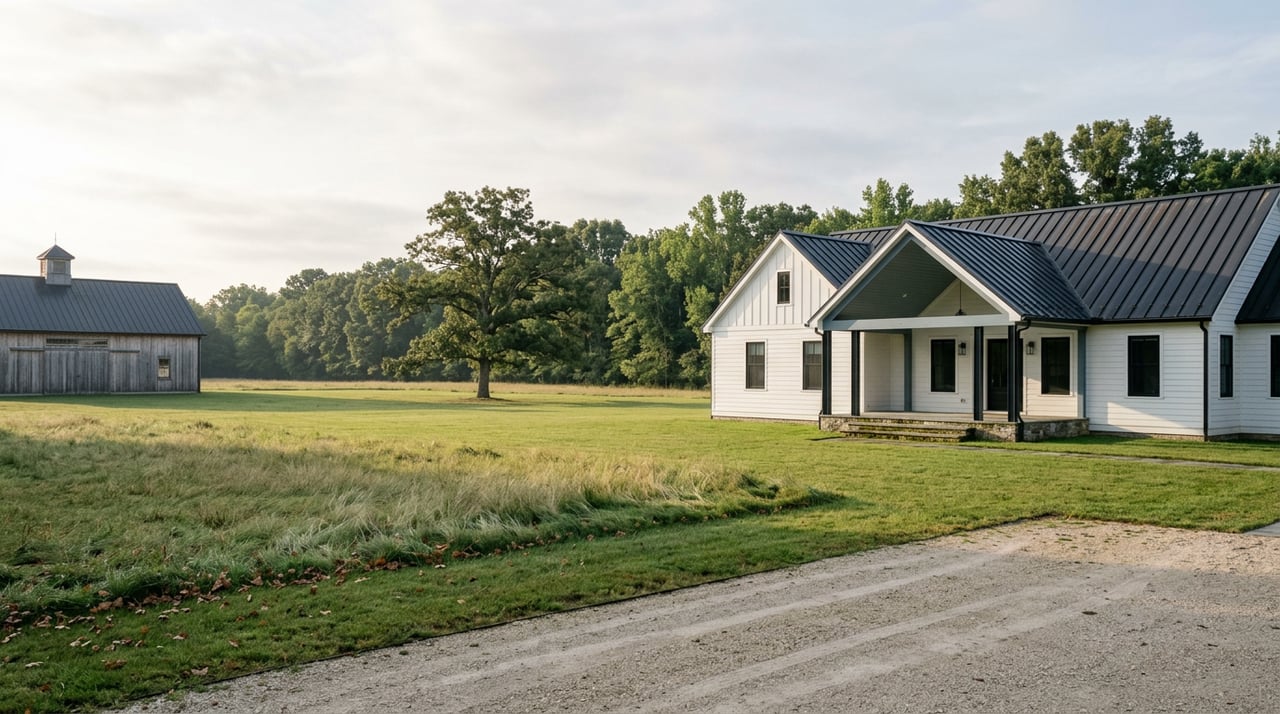
Near Wye Mills, the Median Price Per Acre Is Real. It's Also Nearly Useless.
September 10, 2026
September 10, 2026
A buyer looking at acreage near Wye Mills this fall will eventually run across a number: something in the neighborhood of $58,000 an acre for undeveloped Talbot County land, based on current listings tracked across the county. It looks like a benchmark. It behaves like one for about as long as it takes to open the actual listing.
The number blends three different products that happen to share a zip code. A wooded ten-acre lot with no perc history sells nothing like a working soybean field with tile drainage already installed, and neither sells anything like a 300-acre operation with a farmhouse, equipment barns, and a decade of yield records. Average them together and you get a figure that describes none of them. Buyers who anchor to it end up either overpaying for raw ground or walking away from a working farm that was priced exactly right.
The two things that actually determine what a parcel near Wye Mills is worth, and what you're allowed to do with it, don't show up in the price at all. One is a testing window the county itself can't fix to a date. The other is a state easement program that's been quietly working through this exact area for months.
If a parcel near Wye Mills isn't on public sewer, and most of the acreage in this part of Talbot County isn't, a perc test has to confirm the soil can absorb septic effluent before anyone can build. The Talbot County Health Department runs these evaluations, and its own description of the process is worth reading closely: testing happens during what the county calls the Wet Season, the stretch of the year when groundwater sits at its highest, and that stretch is tracked through a network of observation wells scattered across the county rather than set by a fixed date on the calendar.
That distinction matters more than it sounds. In neighboring Eastern Shore counties, health departments publish firm windows, often closing wet-season testing by late April or early May depending on how wet the winter was. Talbot doesn't commit to a printed date. The window opens and closes based on what the monitoring wells are showing in real time, which means a buyer who wants a perc test scheduled in March can't simply mark a date on a contract. The county has to confirm the ground is ready first.
For a land buyer, this converts a testing requirement into a scheduling risk. A parcel that shows promising soil in a neighbor's old perc records still needs its own current test, run during a window the buyer doesn't fully control, before a lender or a builder will commit. Anyone writing an offer with a tight closing timeline on unproven acreage should ask now, not after ratification, whether the county's wells suggest this is a testing year and what the office needs from the buyer before scheduling.
Sellers pumping and upgrading septic systems have their own version of this timing question. Talbot County channels Bay Restoration Fund grants toward septic upgrades that add nitrogen-removal technology, administered through the county's Department of Public Works. It's a real resource, but it's also a process, and a system mid-upgrade is not the same thing as a system with a clean, current inspection in hand.
Here's where the number breaks down further. Recent land-market data for Talbot County shows farms specifically, not raw acreage, averaging closer to $32,700 per acre, with full farm listings averaging somewhere around $5 to $7 million depending on which tracking service you check and how many working farms happen to be on the market that week. Undeveloped land, meanwhile, runs closer to that $58,000 per acre figure. Those two numbers sit almost $26,000 apart on the same axis, describing land in the same county.
| What's being priced | Approximate per-acre figure | What that figure includes |
|---|---|---|
| Undeveloped land, county-wide | ~$58,000/acre | Raw ground, no crop history, no confirmed septic suitability |
| Working farmland, county-wide | ~$32,700/acre | Tillable ground with an operating history, often larger tracts |
| Documented institutional purchase near Wye Mills | $4,000/acre | 233 acres of agricultural ground purchased under a use restriction |
That third row is the one worth sitting with. In May 2021, the Maryland Board of Public Works approved the University of Maryland's purchase of 233 acres bordering the Wye East River and Wye Narrows, land near its Wye Research and Education Center five miles up the road in Queenstown, for $936,000, a figure the Star Democrat reported at the time as roughly $4,000 an acre. The sale closed the following year. It's an old transaction and not a live comp, but it's a real, sourced number for unrestricted agricultural ground in this same stretch of the Eastern Shore, and it sits nowhere near either of the two averages above it. The gap between $4,000 and $58,000 an acre isn't a typo. It's the difference between land with development rights intact and land that has already been priced, sold, or restricted with those rights stripped out.
That university purchase came with its own history of restriction. The land had originally been gifted to the Aspen Institute by Arthur and Nina Houghton in 1978, and Nina Houghton placed a covenant on it requiring the land stay in educational use and remain open space. When the University of Maryland completed its purchase decades later, the acreage went into a conservation easement held jointly by the Maryland Environmental Trust and the Eastern Shore Land Conservancy, permanently preserving its agricultural and environmental character.
That's an unusually well-documented example, but the mechanism behind it runs on a much larger, active program. The Maryland Agricultural Preservation Foundation has been purchasing easements from willing landowners since 1977, and as of this past May had permanently preserved roughly 393,000 acres statewide. This isn't a historical footnote. In February 2026, the state's Board of Public Works approved eleven new MALPF easements covering close to 1,479 acres across six counties, including Talbot and Queen Anne's, the two counties that meet at the Wye Mills line.
A preservation easement doesn't show up as a line item on a listing sheet. It shows up in the deed, in the property's title history, or in a conversation with the county's agricultural preservation office. Two parcels can carry the identical asking price and mean two entirely different things: one buildable to whatever the zoning allows, the other permanently restricted from residential subdivision no matter who owns it next. For a buyer weighing acreage near Wye Mills against a future home site, a barn, or a rental cottage, that distinction is worth confirming before the inspection period even opens, not after.
None of this argues against buying land here. It argues for treating the advertised price per acre as a starting question rather than a finished answer. Before an offer goes in on acreage near Wye Mills, it's worth confirming three things separately from the price: whether the parcel has a current perc test or only an old one, whether the county's wet-season window realistically allows testing before your closing date, and whether the tract carries or has ever been offered into a MALPF or land trust easement.
The Wye Angus program, still running its 48th annual sale out of the Wye Research and Education Center in Queenstown this past spring, is a reminder that this stretch of the Eastern Shore has spent decades balancing active agriculture against permanent conservation, often on the same ground. That balance is exactly what a buyer near Wye Mills is stepping into, whether the parcel is ten acres or three hundred.
Does an old perc test still count? Neighboring Eastern Shore health departments are explicit that a prior approval does not guarantee validity going forward, since soil conditions, groundwater, or the regulations themselves can change in the years between a test and a sale. Treat a perc test that predates your offer as a starting point for Talbot County's review, not a substitute for a current one.
Can I close on unproven land outside the wet-season window? You can close, but you may not be able to confirm septic suitability first. Buyers moving on a tight timeline should talk to the Talbot County Health Department directly about whether the current wet season is open, closing, or already finished for the year before assuming a test can be scheduled on their preferred date.
If a parcel already carries a MALPF easement, can that ever be removed? Agricultural preservation easements through MALPF are structured to be permanent. A buyer considering land that may already carry one, or that a seller has discussed placing into the program, should treat that restriction as a fixed feature of the property rather than something a future owner can undo.
If you're looking at acreage near Wye Mills, or trying to figure out what a listing price actually represents once perc history and easement status enter the picture, Shawn Moore has spent years working land, farm, and waterfront transactions across Talbot and Queen Anne's counties. Let's Find Your Perfect Home Together.
Stay up to date on the latest real estate trends.
We would love the opportunity to meet with you, discuss the value of your property, and assist you with your next real estate needs! We are looking forward to hearing from you and would love to schedule a time to meet very soon!
GET IN TOUCH WITH OUR TEAM TO LEARN MORE

SHAWN & MEAGAN MOORE
S:(410) 829-6466
[email protected]
M:(410) 200-4462
[email protected]
127 N WASHINGTON ST EASTON, MD 21601