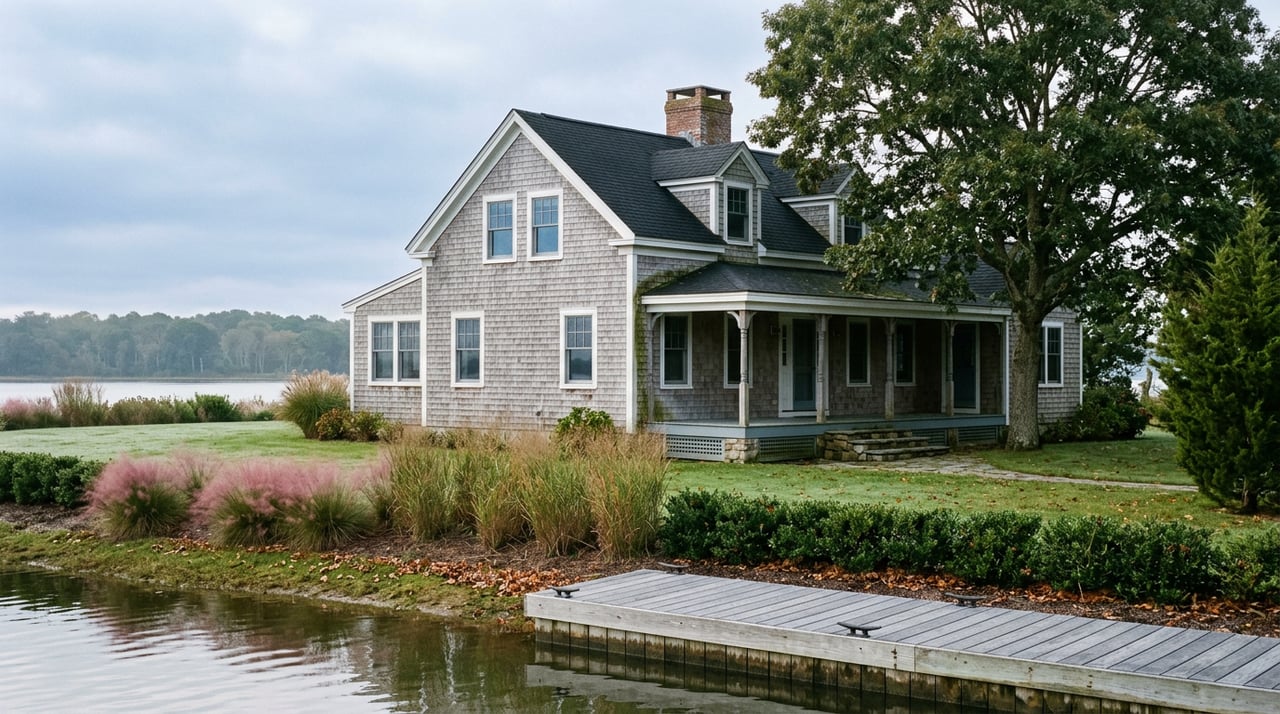
In Royal Oak, the Real Waterfront Line Isn't the Bulkhead. It's the Buffer.
September 24, 2026
September 24, 2026
What happens when the pool you pictured on your new dock lot needs a public hearing before you can pour the concrete?
That is the question a run of Royal Oak property owners have answered in front of the Talbot County Board of Appeals over the past two years, and it is a question worth asking before you write an offer, not after your contractor pulls a permit. Royal Oak's waterfront lots along Oak Creek, the Miles River, and their feeder coves were mostly platted and built out long before Maryland drew a hard line around the Chesapeake Bay's shoreline in 1984. That line, the 100-foot Shoreline Development Buffer, now sits directly on top of decades-old cottages, garages, and patios. The houses stayed. The rules changed underneath them. What that means in practice is the subject of this post.
Talbot County's Critical Area program covers land within 1,000 feet of tidal water, with a stricter 100-foot buffer closest to the shoreline where new development is generally not permitted without a variance. Royal Oak, a rural waterfront village at the southern end of Oak Creek that predates Easton and St. Michaels, is almost entirely inside that Critical Area.
Because so many Royal Oak homes were built in the 1940s through the 1970s, before the buffer existed, county records now describe many of them the same way: legally nonconforming. The structure is allowed to stand because it was there first, but any meaningful change to it has to be measured against a rule that did not exist when the house was framed.
That distinction, standing versus changing, is the whole story.
The Board of Appeals draws a consistent line across its recent Royal Oak-area decisions: replacing something that already exists, in the same footprint and the same use, is usually a straightforward permit. Changing what that footprint does is not, even when the new use is smaller or greener than the old one.
A 2025 case involving a Talbot County waterfront property makes this concrete. The owners had replaced a legally nonconforming gravel driveway with a paver patio inside the buffer after buying the property in 2016. County code enforcement determined the patio was not legal, not because it was bigger, but because a driveway and a patio are different uses under the Critical Area code. The owners paid a fine and went through the full variance process to keep a patio that covered less ground than the driveway it replaced.
That is the trap. A homeowner can reasonably assume that shrinking a hard surface is always progress. Under Talbot County's Critical Area rules, shrinking it while changing what it is used for can still require a hearing.
| Type of project | Typical path |
|---|---|
| Rebuilding an existing deck, dock, or patio in the same footprint and same use | Usually permitted without a variance |
| Converting a driveway to a patio, a shed to a garage, or adding a pool where none existed | Usually requires a Critical Area variance, even if coverage decreases |
| New construction or expansion inside the 100-foot buffer | Requires a variance and a hearing before the Board of Appeals |
The variance requirement is not reserved for major renovations. In 2025, an applicant on Avonia Lane in Royal Oak sought a Critical Area variance for a fence, on a property that had been used for marine purposes for decades before the Critical Area law existed. The Board found the situation unique because the property adjoined a use unlike most residential lots nearby, and it granted the variance with a condition that the fence be an open style agreed upon with the neighboring property owner.
On Swan Road, a different Talbot County case turned on a single sentence in the Board's own findings: the property was the only waterfront home on that road without a pool. The owners were seeking a variance for a patio next to a proposed pool, arguing that most of their nonconforming lot coverage would actually decrease under the new plan. The Board agreed, but only after the applicant demonstrated the patio location was the minimum necessary and reduced overall coverage in the buffer.
A few miles away, owners on Ulmer Road in Royal Oak requested four separate variances in one application, including an after-the-fact permit for a shed that had already been built. Wanting to convert what had been a part-time property into a full-time residence, without disturbing the historic character of the place, meant clearing four separate hurdles with the county at once rather than one.
These are not edge cases. They are what routine home improvement looks like on a Royal Oak waterfront lot that predates the buffer.
Not every request in front of the Board is about a pool or a patio. In one Royal Oak case, a property owner who is paralyzed and uses a wheelchair sought modifications to make her home and shoreline accessible, including paths to a guest house and a pool that had none. Because the property sits in the Critical Area buffer and was developed in 1949, before the Critical Area law existed, any physical change still triggered review. The Board evaluated the request under Maryland's reasonable accommodation standard rather than the ordinary variance criteria and approved improvements designed to be environmentally neutral. The mechanism is the same one running through every case here: change to a nonconforming structure in the buffer gets a hearing, whatever the reason for the change.
If you are evaluating a waterfront home here, the buffer status of the lot deserves the same attention as the dock and the well. A few questions worth asking before your due diligence period closes:
None of this makes a Royal Oak waterfront purchase a bad idea. It means the lot's real constraints live in a folder at the county, not in the listing photos.
If you own a legally nonconforming waterfront property and are thinking about selling, a documented certificate of nonconformity and a clear record of any prior variances make the difference between a smooth transaction and a buyer who discovers the buffer during their own due diligence and gets cold feet. Talbot County's Board of Appeals meets on a regular schedule, and its decisions are public. A seller who has already been through the process, or who can show a clean permit history, is handing the next owner a shortcut instead of a surprise.
Does this mean I can't build a pool on a Royal Oak waterfront lot? Not necessarily. Several of the cases above resulted in approved pools and patios. It means the request goes through a public variance hearing rather than a routine permit, and the Board will look closely at whether the new coverage is the minimum necessary and whether it reduces impact within the buffer overall.
How long does a Critical Area variance take in Talbot County? Every case above involved a formal application, a posted sign on the property, newspaper notice, comment from the Maryland Critical Area Commission, and a hearing before the five-member Board of Appeals. Build that timeline into your renovation plans well before your closing date, not after.
Is Royal Oak unusual, or does this happen elsewhere on the Eastern Shore? The pattern shows up anywhere older waterfront housing predates the 1984 Critical Area law and its 100-foot buffer, which describes a great deal of the Talbot County shoreline. Royal Oak's long settlement history simply means more of its housing stock falls on the older side of that line.
If you are weighing a waterfront purchase in Royal Oak, or thinking about what your own nonconforming lot is really worth once a buyer starts asking these questions, Shawn and Meagan Moore spend as much time reading permit history as they do touring docks. Let's Find Your Perfect Home Together.
Stay up to date on the latest real estate trends.
We would love the opportunity to meet with you, discuss the value of your property, and assist you with your next real estate needs! We are looking forward to hearing from you and would love to schedule a time to meet very soon!
GET IN TOUCH WITH OUR TEAM TO LEARN MORE

SHAWN & MEAGAN MOORE
S:(410) 829-6466
[email protected]
M:(410) 200-4462
[email protected]
127 N WASHINGTON ST EASTON, MD 21601